Want to read a horror review before you buy? Read over 225 full-length reviews of books, games, DVDs, music and more from Flames Rising horror and dark fantasy!
I woke up today without any power which is a large part of the reason as to why this review is a day behind. Not that you needed to know that little fact, or really even, not that my day to day is all that relevant to the review itself. We are living in the 24/7 digital world here, so it shouldn’t matter when I do the reviews, right?
No, wrong. This was the perfect setting to nearly blow all my battery power and candles on writing a review. Especially a review of Survival Horror/ Zombie Apocalypse superstar writer David Moody’s latest book in the autumn series by Thomas Dunne St Martin’s Griffin press. In fact it was probably the most perfect setting to write the review in. Picture it.
This is the third in a series of three reviews looking at the core books for Hellfrost, a setting by Triple Ace Games for the Savage Worlds system. In this review, I will examine the Gazetteer, the third of these three books.
This is my favorite of the three core Hellfrost books, as it can easily be used for any system, not just Savage Worlds. In many ways, it’s not so much an introduction to the regions of Hellfrost, as more of a GM’s Guide to Hellfrost, since it contains some information which might spoil the setting for players. The book is split into three sections, a short Introduction, the lengthy Lands of Rassilon, and the concluding Evil Organisations. The artwork is of the same style as the other two core HF books, and like the other books, contains occasional sidebars throughout that add cultural or historical detail. There is no system information in this book; it is entirely background information for the Hellfrost setting.
The Editorial opens with the promise of a great treat: Wolfgang Baur’s own home campaign is to be written up for publication! Apparently Kobeck is part of it, but the rest of the setting is now to be subject to the Open Design process and brought into the light of day. Wolfgang’s words show his excitement… now I’m looking forward to it as well.
And so to the first article, Ecology of the Gearforged. They started off as an act of desperation, Kobeck’s craftsmen and wizards collaborating to create something, anything to stave off the House Stross forces during the rebellion that saw Kobeck free – but they have matured to more than mere war machines.
This collection of issues, originally released between 2001 and 2004, showcase a variety of Cthulhu goodness, especially for those interested in modern horror. One of the organizations from the Delta Green line, the British occult organization PISCES, takes the spotlight. Since the material within the magazines are basically alike, I’ll tackle the trio together.
The artwork in the magazines comes from a collection of artists and are rather fitting for the Cthulhu Mythos. The first issue has a small amount of artwork (nearly non-existent if not for the well-crafted cartography within it). By the third issue, artwork fills nearly every page and yet doesn’t get in the way of the writing.
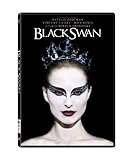
It’s a wonderful time to be alive, at least until the Mayan calendar runs out next year and the sun goes dark. The year is 2011, the internet rules, I have a magic box in my pocket that can access the
sum total of human knowledge, and a balletsploitation were-swan horror flick is a serious contender for five Academy Awards.
Part of the buzz about Black Swan is purely technical: in this film, Natalie Portman realizes the promise she showed way back in Leon (or The Professional, depending on your country of origin). As of Black Swan, she is one of the greatest actresses of our generation.
Not long ago, I signed up for a very cool program with Simon & Schuster called “galley grab,” which allows participants to read e-book galleys in full for a limited amount of time. I’ve loaded up several titles on my nook and am trying to get through them before my time runs out!
One of my first priorities on the list was A Brush of Darkness by Allison Pang, which I’d seen previews for over at Pocket After Dark. There are all sorts of marketing sayings about how many times you have to see something before it sticks, or if you touch something some large number of times, you’ll buy it.
I had a couple of sneak peeks at this volume of Tracker as the issues were being released, and I have to say it’s really nice to see it all together in one volume. The Issue 0 preview and Issue 4 just whet my appetite for what looked like a great werewolf story. As it turns out, the story is exactly what those bits and pieces promised.
Alex O’Rourke is one of the best trackers in the FBI — he’s so good that his instincts are the only thing helping the FBI track down Herod, a serial killer whose vicious attacks look more animal than human. Alex gets into the middle of an attack, following a hunch that Herod will be there, and miraculously survives, recovering on the autopsy table.
You can go many ways with a zombie. Desperate horror is just as likely as Romantic comedy anymore. They are seriously everywhere, which is probably why they are such a threat.
I’m not going to overanalyze them. People much smarter than me have already done that. What I will do is say I ran a super hero zombie one-shot for some friends once and enjoyed the Hell out of it. I also played a convention game where zombies were the main attraction (liked that too). For the most part (and this isn’t fair really), zombie games have a one-shot feel to them. Some games like Zombie Run (an excellent Savage Worlds adventure) and the zillion plus supplements for All Flesh Must Be Eaten suggest ways to make longer campaigns, but I always felt like zombie games were filler (like a blockbuster summer flick) than a campaign (like Walking Dead). I’m hardheaded and wrong, which this book quickly points out.
“ONE THOUSAND OPAS AND A DEAD BODY,” Part Three—A pilfered poison pabulum has pickled pieces of our protagonist’s paunch while portentous poetic prophecies proudly parade apace, parlaying a perilous paradigm. Paraphrasing: SKULLKICKERS is a particularly perfect packaged pamphlet of plucky pulp worth every precious penny in perpetuity. Purchase!”
First of all the “tripping sequence” are you serious? How can you relate that both verbally and visually any better in a comic book? Ridiculous! onto this issue, it rocks. I find myself flying through the pages, not because there is nothing on them of course, but because I get lost in this universe so well.
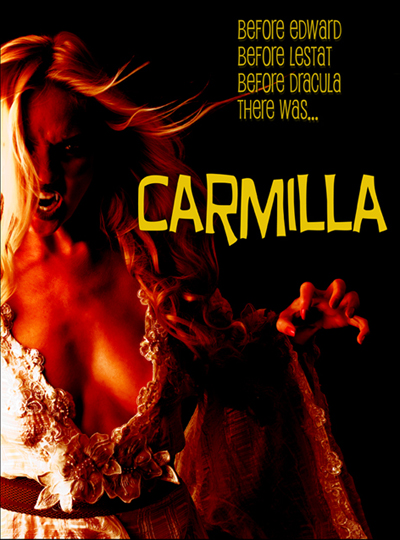
A beautiful young girl, alone in desolate Central Europe. Nightmares. Revenge. Mesmerism. Rationality eroding under the stress of supernatural evil, murder, and disease. Blood. Mere swords against the preternatural strength of the undead. And the world’s first lesbian vampire.
Got your attention? J. Sheridan LeFanu brought these elements together in 1872 — 25 years before Bram Stoker’s Dracula — in his novella “Carmilla”, a story that subtly tilts between the nightmarish Gothic terror-tale and today’s “realistic” horrors set firmly in the waking world. Generations later, Chicago’s Wildclaw Theatre company has adapted “Carmilla” for the modern stage. [Full disclosure: I wrote a short essay, pro bono, on LeFanu for the program book for this production.] Wildclaw’s Carmilla is the latest in a series of adaptations including Machen’s “The Great God Pan,” Lovecraft’s “Dreams in the Witch House,” and William Peter Blatty’s Legion that makes Wildclaw Chicago’s — and perhaps America’s — leading missionary of classic horror to contemporary theater audiences.
This is the second in a series of three reviews looking at the core books for Hellfrost, a setting by Triple Ace Games for the Savage Worlds system. In this review, I will examine the Bestiary, the second of these three books.
The book, not surprisingly, contains a plethora of monsters, archetypes and animals that not only help you populate your Hellfrost campaign with relevant beasties, but also offer some good fodder for any other campaign run using the Savage Worlds rules. For anyone using Hellfrost with a different set of rules, this book won’t be as useful as the other two core HF books, but it will give you some idea of the types of critters out there in Rassilon for you to convert to whatever game system you’re using. In general, the book is great for Hellfrost using SW rules, and ok for anyone using either a different system for HF, or a different setting with SW.
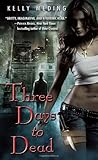
When Evy Stone wakes up in a morgue in a different body than the one she remembers, with no memory of the few previous days, she knows she’s in for a hell of a time. What she does remember is this: her teammates from her bounty hunting career were murdered, the were-people with whom she took asylum were slaughtered by her former bosses, and the only person she thought she could trust was her handler. She has to make contact, convince him that she’s still Evy (despite the new body), and avoid being entangled in the life of the girl who used to live in this frame. Not to mention, as she discovers more about the reasons she ended up in a new body, saving the world. All in a three day time frame. But hey, she’s been through worse. Probably.
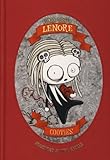
“Lenore might only be small, but her talent for mischief — and occasional wanton destruction — is anything but. Witness the mayhem that ensues when Lenore and friends are attacked by a gaggle of vicious militant mice, and cower in the face of an assault by undead German soldiers from Hell! Never has the term ‘something for everyone’ seemed more sinister and bizarre.”
While I can honestly say that this style may not appeal to everyone, it sure does appeal to me. In my teens I recall watching cartoons like Invader Zim, Agh Real Monsters and even today catching an episode of Courage the Cowardly Dog. So a book like this just comes off to me as looking great.
This is the first in a series of three reviews looking at the core books for Hellfrost, a setting by Triple Ace Games for the Savage Worlds system. In this review, I will examine the Player’s Guide, the first of these three books.
The book introduces the setting of Hellfrost and covers various interpretations of the Core Savage Worlds rules, offers new rules, and governs character creation in the world of Rassilon, as well as providing a very brief introduction to the world. The book is laid out in 11 chapters, with a good choice of art – just about every picture depicts something that is being mentioned on that page, from a woman buying a sword in the gear section, to a mage casting a Zephyr spell on the appropriate page of the magic section. The art is also of a decent standard, and in my opinion, better that that of the SW Explorer’s Edition book.
Anton Strout brings us more madcap mayhem in book two of the Jane chronicles (otherwise known as the Simon Canderous series, but his girlfriend, the ex-evil cultist Jane, totally steals the show). Now a member of the Department of Extraordinary Affairs after leaving her cultist ways behind, Jane is working in the Black Stacks (the scariest library in urban fantasy) and discovering that she has a talent for technomancy. In fact, she’s so good with magic and machines, she rescues her boyfriend Simon from an attempt on his life in his Oubliette test over his cell phone. Her new gig working for the ambiguously moralled Thaddeus Wesker, Director of Greater and Lesser Arcana at the DEA is going swimmingly — except for the tension it creates between her and Simon, who doesn’t like her boss.
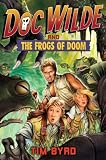
The place of the pastiche in fiction is mixed at best: August Derleth’s Solar Pons is but a pale shadow of Sherlock Holmes, and the less said about Derleth’s “posthumous collaborations” with Lovecraft, the better. But in his collection of linked novelettes, Trail of Cthulhu, Derleth had the happy inspiration to combine the Cthulhu Mythos with Fu Manchu, and the result is a propulsive series of tales considerably above his usual mark. In Doc Wilde and the Frogs of Doom, Tim Byrd goes Derleth one better; he combines Lester Dent’s Doc Savage (as clearly as the laws of copyright will allow) and the Cthulhu Mythos – in the form of a young adult adventure mystery.
Fallen is Babylon is part of White Wolf’s Storytelling Adventure System, a series of well-tailored games that can be picked up for one-shots or slipped (most of the time) into a campaign. This particular setting makes no specific claim to line. It instead provides a town with a curse of sorts. The appearance is that the supernatural isn’t welcome. Vampires cannot sire here, Will-Workers find their abilities bleeding away the longer they stay, and, well, you get the idea. Of course, a mystery like this needs to be investigated.
The Legends of Anglerre RPG (LoA) by Sarah Newton and Chris Birch takes the Starblazer Adventures iteration of the FATE 3.0 system and adapts it for the fantasy genre. This game strives to cover multiple subgenres in the fantasy milieu, with the focus on the Moorcockian swords and sorcery setting of Anglerre, and the high fantasy Hither Kingdoms. The source material for this game is drawn from a series of British comics that appeared in the Starblazer Adventures comic books. References are made to various characters and events from the comics and can at times leave the reader a bit in the dark.
The physical book itself is an impressive tome at just over 380 pages. The cover is full color and depicts three adventurers posing dramatically in a ruined building. The interior of the book is predominantly black and white with the sidebars offset in parchment colored boxed. The artwork is predominantly drawn from the LoA comics.
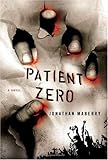
I’ve come to realize, somewhat unwittingly in more recent years, that Maberry scares me for reasons that go beyond the mere horrific. When I made my first serious foray into researching the occult, I didn’t realize until after the fact that my first fact finder’s guide just happened to have been written by the one who wrote this pithy little gem. But then, there’s always something about a writer whose writing not only gives you something you already know, but can serve to inspire other avenues of horror you were certain should have occurred to others by now – only didn’t.
Patient Zero is the first in a series of Joe Ledger novels (not to be confused with the Marvel character), revolving around a former Baltimore detective who is pulled into the shady world of the equally shady Church.
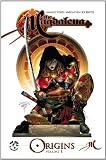
In a comics universe like the one in Top Cow’s Witchblade continuum, characters occasionally crop up who end up needing their own series. Those cross-series first appearances of the Magdalena, the church’s servant for wiping out evil using strength of arms and the ultimate guilt trip: the ability to make a person see all of the evil he’s ever done, are collected in Magdalena: Origins.
Near the beginning of the Darkness series, Jackie Estacado is dealing with plenty of issues (including, apparently, not being able to perform in bed), and he doesn’t really have time to deal with another hero-of-the-week trying to take him down. But, of course, that’s his lot in life now that he’s the incarnation of the Darkness. A Magdalena is dispatched by the church to challenge him and, ideally, destroy him.

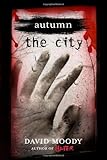 I woke up today without any power which is a large part of the reason as to why this review is a day behind. Not that you needed to know that little fact, or really even, not that my day to day is all that relevant to the review itself. We are living in the 24/7 digital world here, so it shouldn’t matter when I do the reviews, right?




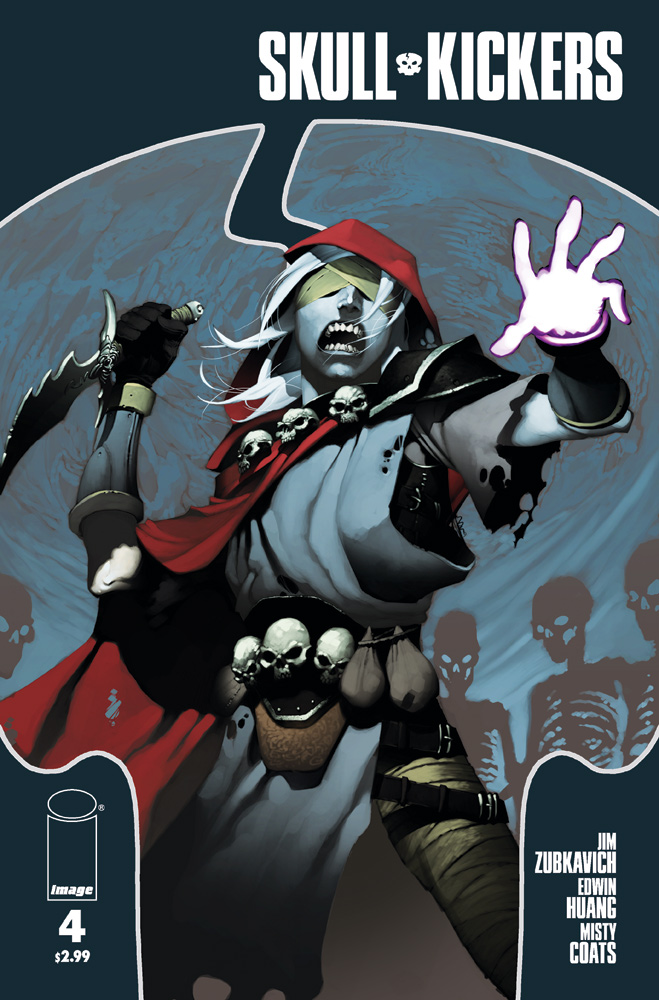 “ONE THOUSAND OPAS AND A DEAD BODY,” Part Three—A pilfered poison pabulum has pickled pieces of our protagonist’s paunch while portentous poetic prophecies proudly parade apace, parlaying a perilous paradigm. Paraphrasing: SKULLKICKERS is a particularly perfect packaged pamphlet of plucky pulp worth every precious penny in perpetuity. Purchase!”