Want to read a horror review before you buy? Read over 225 full-length reviews of books, games, DVDs, music and more from Flames Rising horror and dark fantasy!
THE STARS ARE RIGHT is a board game produced by Steve Jackson Games. Inspired by the Lovecraft mythos, the object of the game is to “summon” ten points worth of servitors and gods before your opponent.
After playing through the game multiple times, I feel that in order to get a sense for what the game is about, you really need to play through it twice. To set the game up, you place the cardboard stars in rows of five by five, for a total of twenty-five. Each player gets five cards to start; I highly recommend giving each player a Turn Sequence card to help keep the movements straight. On the card there are a series of symbols that are used at different points in the Turn Sequence. There are two types of symbols, primarily. The directional symbols allow you to change the way the board is arranged; the pieces are double-sided so there’s a lot of different variations on how the pieces are set up.
Halloween isn’t until tomorrow night, but Barry and his best buddy Shawn are dealing with a monster. Mitch, the school bully has had Shawn marked for sometime now, and he takes it on the chin. Barry encourages Shawn to stand up to Mitch and defend himself, but so far he’s lacked the courage. Ahh, the joys of school.
Later that day the two are looking for a book for a class, but instead they find a very different and much more intriguing book in a secret compartment. Shawn is fascinated by this seemingly “ancient spell book” and studies it throughout that night into the following morning. Shawn even takes it with him when he and Barry go a Halloween party a class mate invited them to. But Mitch is also attending the party and after a confrontation gone bad, he ruins their night and gets them kicked out.
White Wolf popularized a concept nearly twenty years ago. They revolutionized gaming by permitting players to take on the role of the monsters rather than those who slay various supernatural critters. They now offer a deeper layer through their Night Horrors line. See, even the boogeyman is scared of something or some things. This lines opens up the urban legends and myths of the monsters. These are the monsters underneath the monsters’ beds.
I’m reviewing two comp copies from White Wolf today since they have a great deal in common. Both weigh in at 163 pages. Both hold to the same concepts. Both seem to have been given the same amount of creative energy.
I was destined to be a game geek. Back when I was but a wee Stevie, my folks introduced me to board games early. It was a fun and cheap family oriented activity we’d partake in when we could. My folks were big fans of the classics like Monopoly, Clue, Battleship and Trivial Pursuit while occasionally picking up a new “fad game” here and there like The A-Team, Pac-Man and Frogger.
As I got older and found ways of making my own coin, I started buying my own board games, the kinds that caught my interest more than the rest of the clan. These were games with more strategy and story/themes added to them, many of which you fellow board game geeks might recognize. Titles like Risk, The Omega Virus, Dragon Strike, Nightmare, oh yeah… let’s not forget a personal favorite of mine, HeroQuest and its expansion packs. My love of games in general led me to eventually discover RPG’s, which led me to start attending cons, which in turn opened my eyes to a ginormous cornucopia of gaming opportunities! And I dove in head first.
It’s only eighteen pages. There is no artwork beyond some font variances. There are no graphs and no sidebars. You get no character sheet. There are some bullets, but that just seems sensible in a game about zombie survival (or is it Zombie survival?). Despite the utter lack of bells and whistles, it still costs five bucks (except mine was a free reviewer’s copy from Wicked Dead Brewing Company). You know what else?
It’s totally worth skipping out on a combo meal to snatch up this booklet.
Shotgun Diaries apparently started out as a birthday gift. As most things zombie-related, it got a bit out of hand.
I’d wager that most people feel a kinship with one time period or another. Some love the Renaissance so deeply that they model their weddings around the era. For me, I’ve always held a deep appreciation for the Victorian Era. Despite the difficulty historians have attributing a date to it, I fall in line with the generalized trends and historical high points of that period. There is a rather rich environment of Victorian Era gaming; each seems to fill its own niche. Castle Falkenstein has little in common with Ghosts of Albion; however, both are fine games. One writing staple of the era is using ten words when one would do. Charles Dickens, a known abuser of this “sin,” could actually write around all the flowery language. I mention this because the title is a bit wordy and I’m going to refer to this game as Gaslight for the remainder of the review.
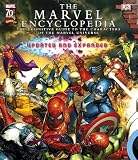
This is a massive tome of all things Marvel. Seriously. It’s a 50 pound hardcover of comic book awesome! Ok, maybe not 50 pounds, but it’s a bullet stopper for sure!
I’ve been a fan of Marvel Comics since I was a kid and the comics took a massive jump to a whopping 35 Cents! Comics have changed so much over the years. More than I knew before delving in to the Marvel Encyclopedia. Holy CRAP! This book delves in to every character, major and minor That I have ever heard of and many I hadn’t. It gives all kinds of details on origins, secret identities, story arcs and issues they are showcased in.
As always, the artwork is stunning. There are several large entries for special groups and events like The Avengers, The Death of Captain America, Civil War, The Gods of Asgard and the many variations of The Hulk.
From the moment you see the cover to Rough Magicks, you know you have something a little demented in your hands. This supplement to Trail of Cthulhu defines magic for that game. You know magic? It’s that aspect to a Cthulhu game that simultaneously levels the playing field (or at least works towards that effect) and causes your character to consider a lengthy stay at the nearest sanitarium. This slight book comes from Kenneth Hite, so the demented disclaimer probably should get mentioned again.
The book’s layout is really tight, but a bit drab. The bulk of the text falls into a three column format, which works well for it. “Chapter” lead-ins are set aside nicely by invoking a certain Twenties style one might find on business cards from that period.
I think one of the coolest parts of writing reviews is not only getting to read a lot of material, but to really get in to the nuts and bolts of how that material is “assembled”. In this case I have been fortunate to read a LOT of Forgotten Realms novel by R.A. Salvatore as well as others such as Paul Kemp. Having read all the “Drizzt Novels” to date, I can say with certainty that the author has improved his craft greatly over the years.
R.A. Salvatore, like any writer clearly has a deep relationship with many of his characters. While some writers are able to outline and crank out material in a mechanical fashion more often then not they go through a sort of adventure of their own; discovering the world and characters as they write. It’s like a journey for the characters as well as the writer. In doing so the author learns to love and hate characters and tries to share it with us…the readers.
It’s been too long since I took part in Live Action Role-Playing. It was the mid-nineties at Egyptian Campaign in Carbondale, Illinois. The Southern Illinois University’s Student Center was the perfect setting for a session of the Masquerade. There were outdoor and indoor sets.
Hectic Narrators bounced all around in attempt to keep the action controlled. It was a great night, but I’m reasonably sure there wasn’t a story to speak of. Yeah, I recall a handful of werewolves being found dead outside the building. There was also something about the Prince being mad. To be honest, the game was an excuse for the largest number of gamers at the convention to cut loose and have fun. After reading City in the Sand, I have to wonder how much better that night would have been with a story underlying everything. I guess I should say a “good story that people were interested in” underlying everything. City in the Sand takes an interesting bit of cinema’s history and applies a little Vampire bite to it.
When I got my mitts on a copy of “The Kill Crew”, I wasn’t sure what to expect from it. I’d never heard of author Joseph D’Lacey before and had no idea what to expect from him. The book itself is only a slim eighty pages and most of my experiences with novella’s of this size haven’t been exactly stellar. However, it was as good of a time as any to dig in and see what Mr. D’Lacey had to say, so I did.
At first my expectations began to dwindle in the first few chapters. The Kill Crew tells a tale about a group of survivors dealing with the aftermath of a zombie like plague. All the zombie fanatics out there will find familiar territory in these first few chapters, especially fans of the comic series The Walking Dead. The zombie’s types here are referred to as “Commuters” due to the fact that they only come out at night and because the majority of these things in life were the commuting white-collared desk jockeys and similar professionals still garbed in their professional attire.
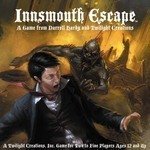
In Twilight Creations’ board game Innsmouth Escape, one player takes on the role of the human trying to free her friends and flee from the accursed town infested with frog-like worshipers of Cthulhu, while the rest play the nefarious Deep Ones themselves, intent on keeping their dark secret away from the prying eyes of outsiders.
The board is a simple six-by-six grid. Some of the squares are marked with symbols indicating places to rescue human captives, obtain equipment and have encounters (all for the human player) and to spawn Deep Ones, summon a Shoggoth (more on that later) and draw cards for the Deep One player(s).
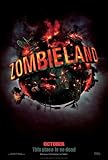
Director Ruben Fleischer’s Zombieland is not a horror movie. It’s not even a horror-comedy. It’s really a fairly straight forward comedy-comedy, the back drop of which involves zombies. And as such it works pretty well, just not as well as its components suggest it should.
The world has been overrun by zombies and a most unlikely survivor nicknamed Columbus (Jesse Eisenberg) is heading east across the country toward home hoping to find others, his family in particular. As fate would have it, he crosses paths with Tallahassee (Woody Harrelson), another survivor heading east and Columbus’ polar opposite in just about every way. Soon the two of them run into a bad girl nicknamed Wichita (Emma Stone) and her twelve year old sister Little Rock (Abigail Breslin). These girls were conning men out of their money before zombies became an issue and have since parlayed their game into a post apocalyptic art of survival as they head west.
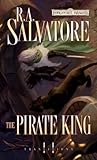
The Pirate King is the second novel of the Transitions series by R.A. Salvatore. The hardcover edition was released in the US on July 2009.
“Captain Deudermont has sailed to the pirate city of Luskan on a mission–a mission to once and for all defeat the true power behind the corrupt city: a wicked lich and his cabal of evil wizards from the Host Tower of the Arcane. But the Host Tower has some tricks up its sleeve, as do the pirate captains who would like to see both sides fail.”
As many know, the Forgotten Realms is changing. With the advent of Dungeons and Dragons 4th Edition the FR timeline is being advanced approximately 100 years. The various “Drizzt Novels” so far have been set earlier in the timeline (corresponding with 2nd Edition AD&D and D&D 3r/ 3.5 Editions). The “Transitions Series” is an attempt to reconcile the two converging timelines, bridging the gap between the setting we all know (and love) and the new setting which has MANY stark differences.
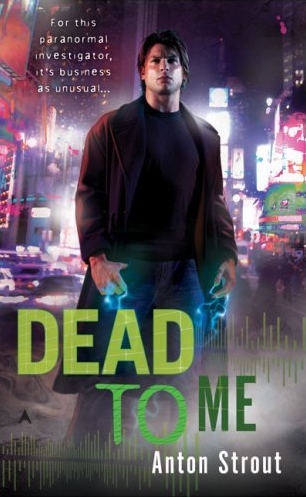
Billed as Jim Butcher-light, DEAD TO ME is an urban fantasy novel for debut author Anton Strout. In this series, the main character (named Simon Canderous) struggles with his psychometric ability while working for the Department of Extraordinary Affairs in Manhattan.
Strout introduces Simon as a conflicted character who hasn’t quite figured everything out yet. His ability allows Simon to get a psychic impression (which is portrayed as if Simon is reliving a memory) off of everything he touches — including people. Sometimes those impressions are multi-layered; sometimes they’re not. His psychometric ability has affected everything from Simon’s moral judgments to his love life and even his health; there is definitely a “cost” to Simon’s inability to control his power.
Eclipse Phase is a new sci-fi setting from Catalyst Labs, which immediately raises the question of why I’m reviewing it for a website dedicated towards horror. Between the fall of humanity and the chaos in rebuilding (where the story takes place) a great many horrors occur.
This is sci-fi with a thick black coat of ichor slapped onto it. While some game masters may be excited about the many, many thoughtful advances in this setting, other game masters will pounce upon the hints of Cthulhu and other horrors. When my review copy for this book came in, I wasn’t sure what to make of it. The title of the book has an eclipse behind it that looks similar to the same artwork used on Heroes. I thought perhaps someone had taken the effort to make a game on that series. The truth is that an Eclipse just looks like an eclipse no matter how you draw it.
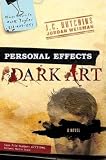
Back on August 14th, a two chapter preview of Personal Effects: Dark Art was posted here on “Da Flames” (Click here to read preview). Included in this preview were notes about this book being a “multi-media novel” or a “trans-media” thriller that makes it a unique experience. By the time I reached the end of the preview, it was an appetizer that made me want to sink my rotting teeth into the rest of the book. Actually, calling it an “experience” as opposed to simply a “book” would be a better description. What do I mean by that? Well folks, grab a fork and a knife and sample this delight with me.
To best review P.E.D.A., I’m going to split “the experience” into two halves. Starting with the book portion (which was author J.C. Hutchins contribution to the experience), our protagonist is mild-mannered art therapist Zachary Taylor.
As my legions of fans know, I’m not fond of fantasy games. I can’t quite define why elves and arrows or clerics and castles don’t appeal to me. Even fantasy settings with a hint of horror like Ravenloft don’t capture the essence of what I look for in a campaign. Ravenloft, however, is on the right track. Today, I’m looking at Fantasy Craft through a dark tint. With little effort, the options provided in this game can make an excellent fantasy or horror setting.
That said, this review will look a little differently as I try to include some seeds to make this setting a little more frightening. Fall is afoot and those shadows will be growing longer. Who isn’t ready for campfires and Halloween?
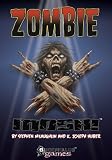
With the runaway popularity of Zombies these days, it isn’t surprising that we’re seeing the shambling undead teamed with nearly every other concept imaginable, from video games to Jane Austen. Even lighthearted zombie treatments are gaining a strong foothold, like Shaun of the Dead, the upcoming film Zombieland starring Woody Harrelson, and, of course, Zombie Mosh from Bucephalus Games.
Zombie Mosh is exactly that, a game about zombies bashing each other apart in a mosh pit. Players select one of six different character cards, then shuffle the Zombie cards and deal four to each player. The dealer then draws two cards and randomly places them in the “damage” row of each player, including himself. Each card has two different results, facing the top and bottom of the card, so orientation of each card matters.
I’m not one for the dungeon crawl. Despite the fact I’ve been gaming since the mid-eighties, catacombs filled with creepy-crawlies that seem to have no apparent food supply just bores me to tears. One thing I do like though are the Choose Your Own Adventure books from days gone by. While Dungeon Crawl can be played with two or three people, it is intended as a solo-game. While it isn’t a new concept (TSR did it with the Marvel Super Heroes line with their title Thunder Over Jotunheim), it is a rather rare one. My allegiances are bitterly torn on this review, so watch out.
Before I go into my standard format, let me explain a little bit about what this game does. This game is part tile-based and part RPG. You take on the role of a character (Human Thief, Elf Sorcerer, or Dwarf Fighter) and stat your character out. They pretend that there are six character types, but differentiating between male and female Elf Sorcerer loses much of its argument when the following politically-correct sentence dictates that there are no benefits or penalties from playing males or females.

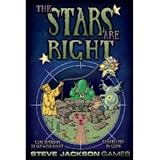 THE STARS ARE RIGHT is a board game produced by Steve Jackson Games. Inspired by the Lovecraft mythos, the object of the game is to “summon” ten points worth of servitors and gods before your opponent.