Want to read a horror review before you buy? Read over 225 full-length reviews of books, games, DVDs, music and more from Flames Rising horror and dark fantasy!
“Donar’s Hammer” is the first of the smaller supplements for “Godlike” RPG, and provides an introductory scenarios as well as optional rules for your “Godlike” game.
Set in Sicily in 1943, players take on the role of a group of Allied Talents that come face to face with a group of Axis Overmen protecting a talent called Mjollnir, the name of the norse god Thor’s mythic hammer. What begins as a simple seek-and-destroy mission instead becomes a fight for survival and the soul of a small town.
This is the second part of the Scion Companion to be released as a PDF, the first having been the Tuatha de Daanan segment and with a couple more to come. It furthers White Wolf’s relatively progressive e-book policy while simultaneously acting almost as a preview for the eventual, finished product and also, probably, cunningly getting people to buy much of the same material twice – can’t really fault them for doing that! This section is all about the powers, the elevated statistics and their consequences, the fields of expertise and the powers within those, additional companions, followers, artifacts, magic and so on.
“The Zantabulous Zorceror of Zo,” by Chad Underkoffler and Atomic Sock Monkey Press, is a game of adventure and wonder set in a world of fairy tales. But the land of Zo is more than just pixies and knights. The game includes classic story elements from almost every childhood fantasy, from “The Wizard of Oz” and “Alice in Wonderland” to “Peter Pan” and “Rudolph the Red-Nosed Reindeer.”
The game uses Underkoffler’s Prose Descriptive Qualities (PDQ) system, which is also used in the super-hero RPG “Truth & Justice” and the manic “Monkey, Ninja, Pirate, Robot: the Roleplaying Game.” In PDQ, characters use Qualities to represent their abilities. Qualities can be anything from skills to beliefs to personality quirks.
After reading the first two issues of Marcus Almand’s comic book, Razor Kid, I’m left feeling surprisingly compelled to read more. Razor Kid is as indie as it gets, but this does not belie the effort that Almand and his revolving crew of artists have put forth in giving readers a superior product.
Issue one introduces us to 15-year-old Alexander Tanaka, AKA Razor Kid, as he fights Kevin Michaels in an exercise of initiation into the C.A.P.E. (Citizens Authorized for Protection and Enforcement) program. Alexander is a boy genius who’s developed an armored super suit equipped with an assortment of blades and devices including cybernetic arms that replace his own which have been amputated. Kevin, 18, provides quite a test as he appears to be a full-blown martial arts badass.
Normally I don’t like to read books in a series out of order–the exception being when I’m reviewing them. I’ve got a couple of second novels that I picked up still lingering on my bookshelves, waiting for me to pick up book one. So it always impresses me when a second or third entry in a series can pick up the story without making you feel like you’re adrift (if you’ll excuse the pun). Heroes Adrift does it incredibly successfully, and though our heroes spend the whole book out of their element, the reader catches up to the action in the first few pages.
The book is a massive one, totalling out to nearly four hundred pages interspersed with illustrations that are mostly small, so that’s an intimidating amount of text, though most of it is background and plots, and thus optional. It includes the general rules, combat rules, character creation, kung fu, secret techniques and powers and an enormous section of plot and background providing a great many hooks and ideas to players and Games Masters alike. The game is complete in one book but be aware that the PDF I am reviewing from lacked the front cover image, this does make a file smaller but I would have liked it to be there. I have also read the hardcopy version.
Lunar rains cascade down upon the blasted landscape of Highpoint. Lunar demons raze the ruins of once-great civilizations and assault the under-realms harboring the last of dying races. Across the surface of this once-great world, only the giant City Mechs hold sway, lumbering across charred and corrupted lands, seeking truth, beauty and a new beginning.
The world of “DragonMech” by Goodman Games is a post-apocalyptic fantasy setting where humans, dwarves, elves and other races have turned to technology to protect them in their final days.
This is a review of the second edition of the game with the name altered from Crimson Empire, which the earlier edition was titled, due to a dispute with Lucasarts. Cursed Empire is a small, independent press game written by Chris Loizou and presented enthusiastically and comprehensively at many UK conventions. This is a weighty book and obviously a labour of love for the creator whose enthusiasm for the game is obvious and infectious. This makes me feel bad about criticizing the game given that it’s such an obvious and singular labour of love, but there are significant problems with it.
In this strange land between waking and sleep, you can wield strange and wondrous powers, but your talents make you a target. Push too hard and you’ll fall asleep. That’s when the Nightmares come to feed. Stray too far from reality and you go insane, eventually becoming one of Nightmares that hunt you. Fight for what you believe and remember who you are, but whatever you do, don’t rest your head.
“Don’t Rest Your Head,” is a roleplaying game of insomnia, madness and super powers written by Fred Hicks and published by Evil Hat Productions.
In this hardcover edition of Anita Blake, Vampire Hunter: The First Death, fans will get both issues in the series, as well as the Anita Blake, Vampire Hunter: Guilty Pleasures Handbook. Published by Marvel with a retail price of $19.99, the book is a prequel to Laurell K Hamilton’s best-selling novel Guilty Pleasures, which is the first in the Anita Blake series.
Adapting a comic book from a novel series isn’t an easy thing to do, because of the novel’s rich format, rife with details and setting descriptions. Additionally, the Anita Blake series is told from the first person point-of-view, which can be challenging to display visually in a graphic novel. Stray too far from the point-of-view, and you may encounter oddities–things that the main character (Anita Blake) may be describing but hasn’t seen yet. A nod to the writing team of Laurell K Hamilton and Jonathon Green, each scene was pointed and specific to Anita’s character.
“The Shab-al-Hiri Roach” by Jason Morningstar and Bully Pulpit Games is a storytelling game about academic life, the pursuit of tenure and the lengths people will go to for success, even if that means swallowing an ancient Sumerian bug and burning down the campus. Billed as a Lovecraftian dark comedy of manners, players take on the roles of assistant- or full-proffesors at the ficticious Pemberton University in the fall of 1919.
Players choose an Expertise for their character, an area of learning such as History or Geology, and two Enthusiams, areas in which they excel and delight, such as Creativity, Manipulation or Debauchery.
Private investigator Vicki Nelson, like most everyone in Toronto, doesn’t believe in the paranormal, but when it appears that the latest serial killer could be a vampire, she’s out of her depth. Retinitis pigmentosa has already cost Vicki her former life as a homicide detective, and she needs specialised help with this case. Enter historical romance writer Elizabeth Fitzroy, or known about town as Henry Fitzroy, the bastard son of Henry VIII. He’s also a vampire, and as he and Vicki investigate, they realise that a vampire may not be to blame – but a demon and a screwed up college kid are.
In the early 1900s, horror writer H.P. Lovecraft created a series of books and short stories set in a dark world beset by cultist, monsters and unfathomable “things” from space and other dimensions. These works collectively became known as the “Cthulhu Mythos,” named for one of the Great Old Ones that slumbered in the lost city of Rályeh, awaiting the end of the world.
Chaosium’s “Call of Cthulhu” horror roleplaying game captures the feel of Lovecraft’s writings and puts players in the roles of investigators bent on uncovering, and surviving, the dark lore of the Cthulhu Mythos.
In this prequel issue, the story is about the contrast between the harm people cause to other people, and the harm that comes from evil beyond our understanding. Told in a very cinematic style with artwork to match, we first meet Danielle, a strong female character who works with Malcolm and Michael for the Organization.
Sent to “take care of business,” they hunt down a man named Peter Moore. In a typical suspense-filled mob movie, you might expect that Peter had already met an untimely death.
Daughter of Nexus is an adventure offering for White Wolf’s fantasy RPG, Exalted. This adventure is published in PDF form and is another prong in White Wolf’s fairly aggressive and welcome acceptance of the PDF medium as a way to do business. This is particularly desirable for Adventures, I think, as the production costs and the sale price can be kept low though, at nearly seven dollars – for which you can get PDFs two and a half times as big and with more content – I still don’t think they’re getting the price point right for their electronic offerings, after all, adventures are pretty much disposable products, with little in the way of replay value and few elements that can be effectively reused.
“And what have you done lately?” So ends a fast-paced, winner-take-all honey of a comic book brought to life. Wanted builds from a nicely sardonic character study through a romp of an action film into a colossal final fight built around a twist that suddenly catapults the movie from a fun night out into an edge-of-the-seat thrill ride. It may start out slowly, but this movie ends with a bang so big, it will leave you grinning with malicious glee. All nice words aside, don’t go to this movie looking for high drama and a soaring intellectual quotient—although the movie does, at times, make witty, ironic jokes worthy of a wry smile. But if you enjoy a dark comic book writ large and riddled with as much wordplay as bullets, then this is the movie for you.
“Godlike” is a role-playing game about super heroes during World War II. But “Godlike” isn’t your normal super-powered game. The heroes, called Talents, are normal people with extraordinary powers, but who ultimately are still very human.
The Talents in “Godlike” don’t dress in spandex and capes while soaring into war. That’s like wearing a giant target on your back. Instead Talents tend to work in small groups, just like a regular military unit, and conceal their extraordinary abilities when possible. The Talents have great power, but ultimately are tools in the war, and a player character’s ability to affect the course of the war is limited and dependant more upon the success of missions rather than just on personal actions.
What do you get when you mix an ancient Sanskrit epic that is integral to the Hindu religion with a graphic novel? You get Ramayan 3392 A.D. Created by Deepak Chopra and Shekahr Kapur, the graphic novel attempts to transcend the boundaries of normal storytelling into this visual medium. Is it successful?
To put Ramayan 3392 A.D. into perspective, think about what it must have been like when Marvel Illustrated’s staff put together Homer’s The Iliad into graphic novel form. This particular graphic novel is a re-imagining–not a re-telling–which is an important distinction to make.
Can you make it to the safety of the helicopter before the zombie hoard makes a meal of you? Do you risk a run for ammo or try to slip past unnoticed? Why not slow them down with a few friends instead?
Players each take on the role of one of four survivors in a town overrun by the undead. The game uses a combination of miniatures, tile laying, dice and cards to simulate the twists and turns of a zombie horror flick. Each player has movement, represented by the rolling of a six-sided die; cards, representing different events or items; and tokens, representing a character’s health and how many bullets they have.
The Blight Elves are a race of elves native to Simarra in the Blood Throne setting. These are basically dark elves dialed up to eleven with the themes becoming those of torture, despair and cruelty, equally dialed up to eleven. This is presented for True20 rules and it will be interesting to see how d20 variants like True20 and Mutants and Masterminds fair in the face of 4th Edition D&D.

 “Donar’s Hammer” is the first of the smaller supplements for “Godlike” RPG, and provides an introductory scenarios as well as optional rules for your “Godlike” game.







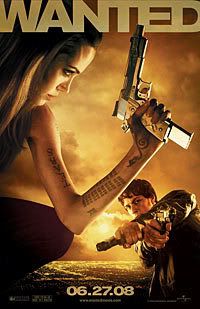 “And what have you done lately?” So ends a fast-paced, winner-take-all honey of a comic book brought to life. Wanted builds from a nicely sardonic character study through a romp of an action film into a colossal final fight built around a twist that suddenly catapults the movie from a fun night out into an edge-of-the-seat thrill ride. It may start out slowly, but this movie ends with a bang so big, it will leave you grinning with malicious glee. All nice words aside, don’t go to this movie looking for high drama and a soaring intellectual quotient—although the movie does, at times, make witty, ironic jokes worthy of a wry smile. But if you enjoy a dark comic book writ large and riddled with as much wordplay as bullets, then this is the movie for you.