Posted on January 12, 2022 by Flames
They Came from Beyond the Grave! is a dramatic, hammy, and horrifying tabletop roleplaying game encompassing the shock, terror, eroticism, and humor of 1970s horror. This game allows you to play with all the magnificent content from the movies of Hammer, Amicus, and Roger Corman, and promises the fun and thrills of the horror movie genre!
In They Came from Beyond the Grave!, you play humans faced with the horrors of the supernatural. You’ll find yourself pitted against vampires, werewolves, ghosts, and constructed critters, along with demons, slashers, and THE DEVIL HIMSELF. Adventures range from the one-shot exploration of a haunted house, to the multi-era play across the 19th century and 1970s.
[...more]
Posted on July 24, 2020 by Flames
Onyx Path Publishing has launched a new Kickstarter for their StoryPath System line of RPGs. A companion to the previous They Came From Beneath the Sea!, you can now jump into campy horror with They Came from Beyond the Grave! Onyx Path describes the new game as:
They Came from Beyond the Grave! is a dramatic, hammy, and horrifying tabletop roleplaying game encompassing the shock, terror, eroticism, and humor of 1970s horror. This game allows you to play with all the magnificent content from the movies of Hammer, Amicus, and Roger Corman, and promises fun and thrills of the horror movie genre!
We had the chance to ask developer Matthew Dawkins about this project. You can also check out some actual play videos from the recent Onyx Path Virtual Gaming Convention too!
[...more]
Posted on June 21, 2019 by Flames
Hello FlamesRising.com readers! Today, we are sitting down with author and biologist Robyn Bennis. Her first novel, an action-packed steampunk tale called The Guns Above, debuted in May 2017. Since then she’s released a sequel titled By Fire Above and a brand new book titled The Devil’s Guide to Managing Difficult People. If you’re curious […]
[...more]
Posted on December 28, 2015 by Flames
 Vampires infesting the mayoral office. Lycanthropes prowling the suburbs. Another kraken making its way upstate along the river. Crazed cultists masquerading as door-to-door religious nuts. Every one of them edging the world one more step toward the next demonic apocalypse.
In your line of work, that’s called Tuesday.
You are an agent of the Brotherhood of the Celestial Torch, hand-picked to serve as Earth’s first and last line of defense against the servants of Darkness. Oh sure, there are others in the Brotherhood who seem more hand-picked than you were, and yes, you probably only work out of a small office somewhere in Michigan or Wyoming or South Dakota, but when it comes to dealing out the damage to the infernal instruments of Hell taking over that shopping mall or the Craz-E-Mart, the buck stops with you.
Lock and load, baby.
[...more]
Posted on November 10, 2014 by Flames
It’s that time! After Daylight, your one-stop shop for satirical vampire comedy/drama with a splash of socially-aware snark (okay, maybe more than a splash) has been updating faithfully as a weekly webcomic since August of 2012. Now 100 hand-shaded pages are in the can, the grand plot arc of the first “season” is all wrapped up, and it’s time for it to sail out into the world in gorgeous print.
[...more]
Posted on October 18, 2012 by Flames
 The Sugarpocalypse is nigh, and it’s up to Clea Brown to stop the saccharine hoard of the undead and defeat the evil Yumzy Corporation.
When a brand new candy bar starts turning people into zombies in the small town of Sweetooth, it is up to Clea brown, and her ragtag group of friends, to stop the EVIL Yumzy corporation from reigning down the Sugarpocalypse!
Once Clea just wanted to escape from her town, now she wants to take it back! And she’ll do so a la lollipop – the perfect tool with which to behead the undead.
Find out more information and back this project at Kickstarter.com!
[...more]
Posted on February 25, 2012 by Flames
Kickstarter Launched For New Card Game Velociraptor! Cannibalism!
Raptors in monocles and silly hats graft strange body parts to themselves and eat their own kind. That might seem like an odd premise for a game, but the team behind Velociraptor! Cannibalism! thinks gamers will love playing these vicious and rather stylish dinosaurs. Based on a crude and inaccurate understanding of natural selection, this game pits players against each other as they devour adorable animals, steal eggs, and eat their own bodies to survive. This card game with a twisted sense of humor was created by six game designers who met for the first time at IGDA Philly’s Global Game Jam site in January. In 48 sleepless hours, Velociraptor! Cannibalism! was born. After a wildly enthusiastic reception, the team wants to bring a polished finished product to the unsuspecting public.
[...more]
Posted on August 24, 2011 by Monica Valentinelli
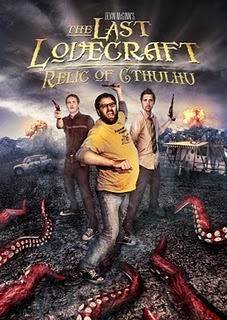 I just had the chance to watch The Last Lovecraft: The Relic of Cthulhu and I was impressed! For an independent film (one that has also won a couple of awards, I might add) this is an awesome film. What’s it about you ask?
Well, there is a story to be told here and quite honestly, the reason why this is a mini-review is because I really don’t want to spoil it for you. I feel this is the type of film you have to discover… laugh out loud… groan… And realize the costuming is just that much better than Mighty Morphin Power Rangers or The Keep.
Part of what makes this movie strong is the characterization and the nerdly discussions, but there are some other surprises hidden between the script’s pages.
[...more]
Posted on July 29, 2011 by Flames
 This preview and the images were provided with permission from the publisher as part of FlamesRising.com’s continuing coverage of Steve Jackson Games Week. Today, you’ll find images of upcoming Munchkin Games including Munchkin: Axe Cop, Munchkin Zombies 2, Munchin: Conan and a few other Cthulhu-related treats.
From Steve Jackson Games to our dice bags, there will be an attractive plethora of custom and jumbo die this Fall for Cthulhu Dice, Fairy Dust and Munchkin Jolly. One color in particular stood out in our minds. We regard it as watered down red, but you’ll probably look at it and go… Pink? Pink Cthulhu Dice? With SPARKLES? It’s almost as if they know we’ll lose sanity just by picking one of them up. Well, if that doesn’t cause you to go a little insane, the giant foam Cthulhu Dice (pictured above) probably will. Instead of marbles? Think Silly Bandz in the shape of Cthulhu. Oh. My.
[...more]
Posted on July 28, 2011 by Billzilla
 Steve Jackson has dominated the games industry lately with a seemingly endless supply of Munchkin-related games, accessories and knick-knacks. Just to prove there’s more going on at Jackson Labs than Munchkin, Steve Jackson Games released Zombie Dice last year to great acclaim. That acclaim is well-earned: Zombie Dice is fast, fun and addictive, and it’s cheap to boot.
Zombie Dice includes 13 dice, instructions, and a dice shaker/storage container in the package. The instructions are very simple: you (as the zombie) roll three dice at a time, and pick them out of the cup without looking at them. If a brain logo comes up, hooray! – you’ve successfully eaten some brains; set those aside.
[...more]
Posted on July 27, 2011 by Matt-M-McElroy
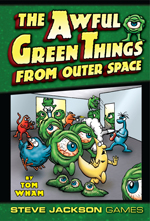 The crew of the exploration ship Znutar just wanted to cruise around the Galaxy, discovering strange new worlds and playing pool. But then their ship was invaded by the Awful Green Things . . . and suddenly they were fighting for their lives!
I recently had the chance to try this game. Amazingly, I had never even demoed the Awful Green Things From Outer Space before. I’d seen it sitting on the shelves of the local game store before and thought it looked like fun. Naturally, I played the role of the alien monsters the first time out, but both sides are just as fun in the end.
Before game play can begin, there’s a little set up involved in this primarily two-player (or two teams) game. First, the Znutar crew has to be placed into different locations on the ship. Then, players need to resolve the starting locations for the Awful Green Things, weapons, etc. Once you’ve played a few times, the set up will go fairly quickly. It took us about five or ten minutes to set up the game the first time we played.
[...more]
Posted on January 26, 2011 by DecapitatedDan
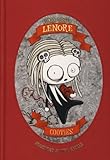 “Lenore might only be small, but her talent for mischief — and occasional wanton destruction — is anything but. Witness the mayhem that ensues when Lenore and friends are attacked by a gaggle of vicious militant mice, and cower in the face of an assault by undead German soldiers from Hell! Never has the term ‘something for everyone’ seemed more sinister and bizarre.”
While I can honestly say that this style may not appeal to everyone, it sure does appeal to me. In my teens I recall watching cartoons like Invader Zim, Agh Real Monsters and even today catching an episode of Courage the Cowardly Dog. So a book like this just comes off to me as looking great.
[...more]
Posted on September 6, 2010 by Eric Pollarine
 Ah yes, here we go. So when I was at Wizard World Chicago, see previous blog article on said adventure, prior to going into the actual convention I met up with Matt, our very fair minded and –not to be a kiss up, but really, in to in fact be a kiss up-wonderful editor handed me a box, which he so apply and verbally labeled as a “Christmas Present.” I asked as we stood in the lobby of the hotel, whether or not “Johannes Cabal the Detective,” was in the box or not? To which, of course there was the obvious reply, yes. But the man wears sunglasses to obfuscate his eyes, which I believe hide his own supernatural abilities. Point being, I am scared of him, so I didn’t press the subject.
[...more]
Posted on August 31, 2010 by Monica Valentinelli
 Last week, I was able to sit down with Steve Jackson from Steve Jackson Games and a group of playtesters at ACD Games Day to play a round of the upcoming Munchkin Zombies game.
Having played several flavors of Munchkin, I thought I knew what to expect when we started to play. I couldn’t have been more wrong. You see, I thought this game would be like Munchkin: Cthulhu, where you play humans that have the potential to turn into zombies. Boy, was I off-the-mark! In Munchkin: Zombies you play…a zombie! Immediately, I was struck by how disgusting and wrong the cards were. Class cards cover all the different zombie types from your favorite movies, books and world myths. There are Strong Zombies, Fast Zombies, Plague Zombies — even Atomic Zombies! There’s also also the chance you can pick up different types of zombie Mojo, too, which functions as a special ability.
[...more]
Posted on November 7, 2009 by Flames
Spectrum Games is pleased to announce the release of Bloodbath Hotel, a whopping 139-page adventure for Slasher Flick. Written by Gregg Helmberger and Kim Foster, this adventure puts the players in the role of ghost hunters investigating a long-since abandoned hotel that was once very opulent. But when they start getting picked off one by one, the remaining characters have to figure out who – or what – is responsible. Will they escape with their lives intact or will they become the latest victims of the hotel?
[...more]
Posted on November 2, 2009 by Flames
 Edited by Martin H. Greenberg and Kerrie Hughes, ZOMBIE RACCOONS AND KILLER BUNNIES is a collection of anthologies that explore the darker side of your favorite woodland creatures like raccoons, bunnies, snakes, bats and more! For this collection, the short stories range from humorous to gory and everything in between. Additionally, the stories explore multiple genres like modern horror and science fiction. Before we offer you a few samples of select short stories from this horror anthology, we’d like to highlight the titles in this book, which was published by DAW in October 2009.
[...more]
Posted on October 26, 2009 by Monica Valentinelli
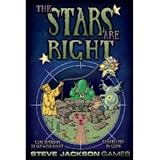 THE STARS ARE RIGHT is a board game produced by Steve Jackson Games. Inspired by the Lovecraft mythos, the object of the game is to “summon” ten points worth of servitors and gods before your opponent.
After playing through the game multiple times, I feel that in order to get a sense for what the game is about, you really need to play through it twice. To set the game up, you place the cardboard stars in rows of five by five, for a total of twenty-five. Each player gets five cards to start; I highly recommend giving each player a Turn Sequence card to help keep the movements straight. On the card there are a series of symbols that are used at different points in the Turn Sequence. There are two types of symbols, primarily. The directional symbols allow you to change the way the board is arranged; the pieces are double-sided so there’s a lot of different variations on how the pieces are set up.
[...more]
Posted on October 16, 2009 by Monica Valentinelli
 *cue ominous music*
They’re creepy and they’re kooky… Mysterious and spooky…
My first nomination for the Girls of Gore series went to Eve from THE MENAGERIE, the world’s first female (and vampire). In this edition of Girls of Gore, I’d like to turn your attention to the lovely Morticia Addams, who is definitely more than what she seems. Now, you might think that Morticia is just another pretty goth that’s all dressed up with nowhere to go, but you’d be wrong. Dead wrong. She may dress in the finest, black gowns and take extra care of her appearance, but Morticia is definitely a Girl of Gore. Why? Well, read on.
[...more]
Posted on October 9, 2009 by Monica Valentinelli
 This week, to celebrate Crackle.com’s Zombiefest, I decided to check out a few zombie-licious movies. One of the movies is called “FLESH EATER.” Now normally, I don’t really like a lot of cheese with my zombies, but this was just…too horrifying to watch without cracking up.
[...more]
Posted on October 5, 2009 by Jason Thorson
 Director Ruben Fleischer’s Zombieland is not a horror movie. It’s not even a horror-comedy. It’s really a fairly straight forward comedy-comedy, the back drop of which involves zombies. And as such it works pretty well, just not as well as its components suggest it should.
The world has been overrun by zombies and a most unlikely survivor nicknamed Columbus (Jesse Eisenberg) is heading east across the country toward home hoping to find others, his family in particular. As fate would have it, he crosses paths with Tallahassee (Woody Harrelson), another survivor heading east and Columbus’ polar opposite in just about every way. Soon the two of them run into a bad girl nicknamed Wichita (Emma Stone) and her twelve year old sister Little Rock (Abigail Breslin). These girls were conning men out of their money before zombies became an issue and have since parlayed their game into a post apocalyptic art of survival as they head west.
[...more]