Want to read a horror review before you buy? Read over 225 full-length reviews of books, games, DVDs, music and more from Flames Rising horror and dark fantasy!
Adapting a beloved book series into another format is brimming with challenges. What goes into your head is rarely what you see and/or hear in the adaptation. Even a movie winning the Oscar is decried by patrons of the source material. The Dresden Files is no different. In spite of the pitfalls, Jim Butcher has not shrunk from putting his work in as many different formats as possible. The Dresden Files received the TV treatment. This was met with condemnation from many fans, but I must admit that though I didn’t enjoy the show, it was what first made me notice Butcher’s work. A new roleplaying game is out, something that fans of Jim Butcher know he would certainly have taken particular joy in seeing. And a limited series of comics entitled Welcome to the Jungle has been out and received positive reviews from this site and others. But Welcome was an original story. Storm Front is a true adaption of the first Dresden Files novel.
I wasn’t overly familiar with the works of John Wick before I picked up the first two Acts of this Curse of the Yellow Sign series (presumably a trilogy), but on the strength of what I’ve read I’m encouraged to seek out more. That’s always a good sign (pun not intended). Since then I’ve noticed that his name has been linked to some other reputable games, such as Legend of the Five Rings and 7th Sea and, more recently, Houses of the Blooded.
To a certain extent there is much to compare the Curse of the Yellow Sign series with the trilogy of scenarios within the Chaosium monograph Ripples of Carcosa – three scenarios that explore the ‘Hastur Mythos’ over different eras.
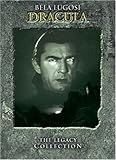
There have been several hundred vampire movies made over the last 90 years. The vast majority of these are uninspired clones of the archetypal blood sucker portrayed by Bela Lugosi in 1931. However, there’s a small minority of vampire flicks that are ambitious in their recipes of blood-fiend lore. Some of these movies are great, others are merely good, but all of them are unique, entertaining, and deserving recognition based on their own merits.
From their beginnings in ancient Sumeria, the Daeva have specialized at blending in with human society. In game terms, Gangrel may be the most overtly kick-ass clan due to their mastery of the Protean powers of shape-changing — able to sink into any patch of earth at sunrise, or to instantly grow claws and throw down. Daeva, on the other hand, have mastery over social skills, and the most efficient character builds tend to reflect this and play to that strength. Daeva may not be quite the combat powerhouse that a Gangrel can be, but they excel at manipulating others, inspiring desire, devotion and need.
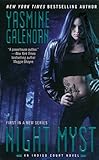
NIGHT MYST is the first book in a vampire series by Yasmine Galenorn. Written in the first person point-of-view, the premiere novel of the Indigo Court focuses on Cicely Waters: who she is, who she was and who she might become in the midst of a deadly power struggle between two, different types of vampires.
At this point, I’d like to point out that while I’ll make every effort not to include spoilers, there may be some in this review. Consider yourself warned. As a reader, I often approach a new vampire series with some amount of hesitation, because vampires, in my mind, should be monsters.
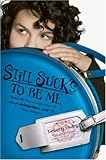
First off, I’m going to tell you, do not read this book without reading the first book in this series – Sucks to Be Me: The All-True Confessions of Mina Hamilton, Teen Vampire (maybe). Since I didn’t read the first book, I had to make some assumptions about what was previously written – hopefully most of my assumptions are correct. Although I tried not to divulge too many key points in the book in my review, there are some spoilers here, so reader beware.
This is a story about a teenage girl named Mina who, having just turned into a vampire, learns that her family has to move away from California. So, the Vampire Council (VC) plans the “death” of her entire family in a tragic accident, reinvents their family history…
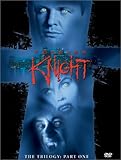
Nick Knight doesn’t sparkle, he doesn’t exude sexuality (though many of his fans seem to think so), and he doesn’t fight other unabashedly good looking werewolves. No, Nick Knight fights for his soul the old fashioned way, through solving bizarre and often Vampire centric homicides. And if you don’t know who Nick Knight is, well then you probably have had a life outside of Canadian, cult status, vampire television since before the dawn of the internet.
Forever Knight was a Canadian television series about an 800 year old vampire working as a homicide detective in the then ultra sleek and hip city of mid 90’s Toronto. His whole existence was one of self hatred and loathing, and his main goal in life seemed to be atoning for the sins he had committed throughout the centuries as he preyed on humans.
Usually I review advance copies from BL, but this one I went and bought because I missed it previously and enjoyed The Shadow King, part 2 of The Sundering.
The subject of this novel poses an interesting problem – a challenge for the author as well as the reader, I found. For those unfamiliar with Warhammer lore, Malekith is a very dark character. Son of the Uber High Elf king Aenarion – who was at once great and terrible due to his drawing of the Sword of Khaine – Malekith is destined to become THE ultimate villain for the race of elves for millennia to come (along with his twisted mother Morathi). Knowing this the author has to tell a tale we will read. To do that, we have to somewhat sympathize with the main character; this is a tall order.
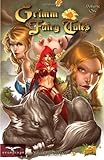
The way that publishers and authors present a fairy tale has always been somewhat interesting to me, because the tales I’ve read are often a mixture of advice, local customs and fantasy. Characters either live happily ever after or they wind up in the midst of a tragic situation they cannot find their way out of. GRIMM FAIRY TALES, published by Zenescope Entertainment, takes a much more traditional view of the fairy tale. (You may recall that Zenescope Entertainment is the same comic publisher that will be producing the CHARMED comic based on the television series.) Zenescope encourage their readers to “enter a world where morality is constantly tested and the shocking repercussions of one’s choices must always be faced.” In this first collection of full color comics, there are six fairy tales to explore: Red Riding Hood, Cinderella, Hansel & Gretel, Rumpelstiltskin, Sleeping Beauty and Robber Bridegroom.
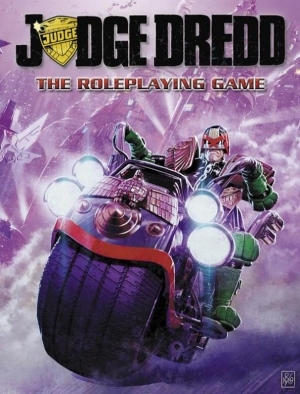
Most people who are likely to pick up this book will already know who Judge Dredd is (from his origins in the 2000AD comic or the movie), but unlike many games based on books, TV shows or films, there is ample information for those who do not know the original inspiration to get a feeling for what is going on, for the Judge and his world. The Introduction encapsulates the situation. In a radiation-ravaged world vast sprawling cities hold most of the surviving population in relative safety, but law and order is a massive problem that conventional systems of police and law courts could not maintain, hence the Judges – who act as police and court and often sentencing agent as well – developed to keep some semblance of order.
Hard Helix is a series of scenarios for Mutant City Blues, written by Robin Laws. The whole thing clocks in at 78 pages, including intro text and all that. This is to say, the scenarios are compact. I’ll lay it out on the table; this is a good thing. If you’ve read my review of Mutant City Blues, you’ll know that I greatly appreciate the design concepts presented. Hard Helix keeps those up. It’s a supplement packed with content from beginning to end. Robin doesn’t waste words, here.
The first adventure is Hard Helix, something of a political exercise. It has a relatively large cast, and sets up some interesting ‘canon’ characters for the setting.
Advertising will sometimes try to sell a movie as the funniest of the year . . . during the third week in January. I think that’s a fairly short-sighted marketing approach, but maybe people don’t remember that eleven more months will doubtlessly have contenders to the self-proclaimed title. Why even bring it up? Because I want to explain my take on this RPG. I’m not going to call this the coolest RPG I read in 2010 . . . yet.
OKKO: THE CYCLE OF AIR, BOOK ONE is the third cycle in the OKKO series from Guy Delcourt Productions and Archaia Entertainment, LLC. It stands well on its own, though reading the other cycles in the series (Water and Earth) and knowing some of the background of the setting will no doubt lend more fluidity to the events of the story.
The plot focuses on Samurai Okko, his entourage, and their attempts to help a girl that is seemingly haunted by spirits.
In horror circles, one of the things the last decade will be remembered for is a zombie renaissance. The walking dead have been everywhere, from the big screen to books and from comics to games. The dead literally have been taking over the world. Well, insofar as cheap entertainment is concerned. As is always the case when a niche becomes a commodity, the genre becomes oversaturated.
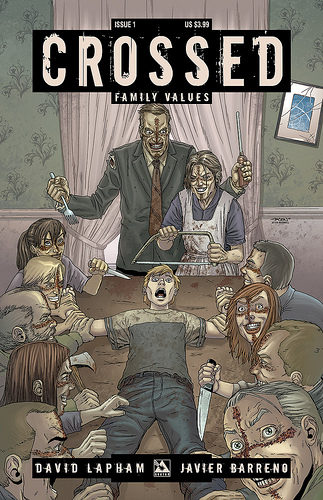
“Nothing is sacred as Crossed returns! The biggest hit horror series of the year returns with an all-new six-issue series written by David (Stray Bullets) Lapham! Set right at the start of the Crossed outbreak, this epic tale of depravity promises to shock and disturb you with even more intensity than the first series! The Pratt family lived a idyllic life on a horse ranch in North Carolina. A few generations of family working, living, and learning together. But not all things should be shared with, nor done to, other human beings. Much less your own family. Some men are just born evil, some men are turned Crossed. But which is worse? Imagine, for a moment, the worst crimes against humanity.
The Introduction lays out the intention of this work: to provide an optional systematic approach to magic that can be used within a Trail of Cthulhu game by the characters and/or their antagonists as the Keeper so chooses. Well, the antagonists probably will be using magic at times, but not necessarily according to a set of rules; their spells may be created as appropriate for the needs of the adventure being played.
The first chapter – Which Magic? – goes into greater detail about sources. Naturally, Mythos literature looms large, but Lovecraft was by and large unclear about the underlying mechanics of his magic, using it to create the desired effect without much regard to what was going on.
Before I dive into this review, let me point out that it reads differently. I think a good review should not only weigh a product’s pros and cons. No, they should also speak to previous tastes and biases. Comparisons. Rather than dwell here, let’s dive right into the Hellfrost: Bestiary review.
Hellfrost: Bestiary (Triple Ace Games; 132 Pages) is a massive collection of fantasy monsters for the Hellfrost setting and Savage Worlds’ game engine. The book covers all manner of vile creature from the evil deer (page 20) to truly loathsome Dread Liche (page 84). These antagonists also offer many variations of trouble for PCs. There are “tanks” with toughness of 23, psionics, pesky swarms, and mystical adversaries. Trouble. Loads of trouble.
I’ve been put through the literary meat grinder recently with good books like Darkness on the Edge of Town and On the Third Day. So I figured it was time to read something a little lighter of subject; something not quite so epic this time around. You know, something frightening… but fun! To that end, my reviewer’s copy of Bigfoot War couldn’t have come in the mail at a better time!
I’ve never read a Bigfoot horror story before; to be honest, most of my experience with Bigfoot comes from either watching Harry & the Henderson’s or watching the car crushing eponymous monster truck. I knew nothing about author Eric S. Brown either, but fortunately he spilled his own can of beans in the book’s introduction.
War is unending in the life of a Space Marine. After defeating Tau forces, Captain Uriel Ventris of the Ultramarines has returned to the Chapter’s homeworld of Macragge, but there is little respite. The Ultramarines are thrust back into battle, and this time the enemy is the Chapter’s greatest nemesis. The traitorous Iron Warriors, led by renegade Warsmith Honsou, have gathered together a massive and brutal warband. Their target is the realm of Ultramar. Their objective is total annihilation. It is a final showdown between legendary Space Marines, and Uriel Ventris must take on the might of Honsou if he is to save his Chapter’s homeworld.
INSYLUM, a role-playing-game by Dennis Detwiller, has players locked away in an asylum as Patients, with the gamesmaster playing the asylum Facilitator hoping to cure them. The Patients are all linked in a strange and vague way, all recollecting fragments of their past. At night they are able to escape their cells, venturing out into a surreal dreamscape beyond the walls of the asylum, known as The Night World.
I’d suggest the game is for experienced gamesmasters with some knowledge of the background material (see below). The Patients all begin the game with amnesia. They all have the same stats (and only three of those). The core premise is that that they have no memory of why they’ve been locked away, and their key motivation being to discover the truth that sent them there, by regaining first Lucidity and then Memory. Only by regaining Memory can the Patient hope to be cured.

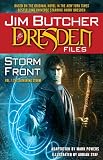 Adapting a beloved book series into another format is brimming with challenges. What goes into your head is rarely what you see and/or hear in the adaptation. Even a movie winning the Oscar is decried by patrons of the source material. The Dresden Files is no different. In spite of the pitfalls, Jim Butcher has not shrunk from putting his work in as many different formats as possible. The Dresden Files received the TV treatment. This was met with condemnation from many fans, but I must admit that though I didn’t enjoy the show, it was what first made me notice Butcher’s work. A new roleplaying game is out, something that fans of Jim Butcher know he would certainly have taken particular joy in seeing. And a limited series of comics entitled Welcome to the Jungle has been out and received positive reviews from this site and others. But Welcome was an original story. Storm Front is a true adaption of the first Dresden Files novel.